


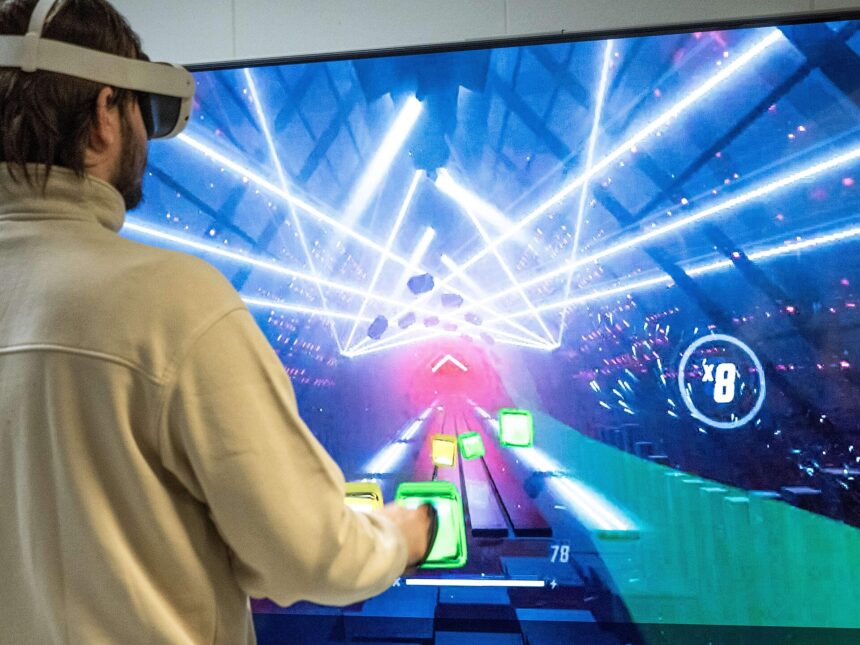
Virtual reality has always promised a simple fantasy: step inside the game and walk around. In practice, most players still move with a thumbstick while standing still in a living room. A new partnership between Virtuix and Meta aims to close that gap. Virtuix, the company behind the Omni One omnidirectional treadmill, will sell the system bundled with Meta Quest headsets, packaging the hardware players need to walk, run and crouch in virtual worlds into a single purchase.
The announcement matters less for the bundle itself than for what it signals. VR movement, long treated as a specialist accessory for arcades and enthusiasts, is being positioned as a natural extension of the best-selling consumer headset line. Readers following our entertainment coverage will recognise the pattern: technology goes mainstream when it stops demanding that buyers assemble it themselves.
How the Omni One actually works
The Omni One is not a treadmill in the gym sense. There is no moving belt. Instead, the player stands on a smooth, dished platform wearing low-friction overshoes, secured by a support arm and harness that keep them centred. As the player walks or runs, their feet slide across the surface, and sensors translate that motion into movement inside the game. Turn, strafe, back up or sprint: the direction comes from your legs, not from a controller.
That design solves two classic VR problems at once. The first is space. Free-roam walking normally requires a large empty room, and even then players eventually reach a wall. The Omni keeps the player in one compact footprint. The second is motion sickness, which for many people is triggered when their eyes report movement their body does not feel. When your legs genuinely move, the mismatch shrinks, and sessions tend to feel more comfortable and more convincing.
Why the Meta bundle changes the maths
Compatibility has been the quiet obstacle for VR treadmills. A buyer needed the right headset, the right software support and the patience to configure both. Bundling the Omni One with Quest hardware, as Virtuix describes its consumer push, turns a research project into an appliance. Unbox it, put on the headset, and the system is designed to work as one product.
It also places the treadmill inside Meta’s content ecosystem rather than outside it. Quest’s library is where most consumer VR spending already happens, from fitness apps to shooters to social worlds. If Omni support becomes a feature developers can assume rather than a curiosity they must specially support, more titles can be built around real walking from the start, instead of adding treadmill modes as an afterthought.
Gaming first, fitness close behind
The most obvious winners are games built around exploration and physical play. Walking a game world at your own pace feels fundamentally different from gliding through it, and developers have long said presence, the feeling of actually being there, is VR’s strongest asset. Everyday browsing of our homepage shows how often entertainment and wellness now overlap, and the Omni One sits exactly on that line.
Fitness may prove just as important commercially. VR workouts already attract people who find treadmills and stationary bikes monotonous. A system where movement through a game world is the workout, measured in real steps, real distance and real effort, turns exercise into a side effect of play. For households, that dual use helps justify a premium device that might otherwise look like a single-purpose toy.
The honest obstacles
None of this makes the Omni One an impulse buy. Omnidirectional treadmills are premium hardware, they take up dedicated floor space, and players still need room to swing their arms safely. Content support will decide the bundle’s fate: a treadmill that works beautifully with a handful of titles is a novelty, while one supported across a growing Quest catalogue becomes a platform.
There are human questions too. How tiring is a long session? How quickly do new players learn the sliding gait? And how well does the system handle different heights, weights and mobility levels? These are the details that reviews and retail demos, not launch announcements, will settle.
What to watch next
Watch three things: the bundle’s final price and availability, the list of Quest titles confirmed to support natural walking at launch, and whether other accessory makers follow Virtuix into headset partnerships. If the bundle sells, expect movement hardware to be marketed the way racing wheels and flight sticks are for simulators: as the upgrade serious players eventually want.
For now, the Virtuix and Meta deal is best read as a statement of intent. VR’s next step may literally be a step, taken by the player, in their own living room.