


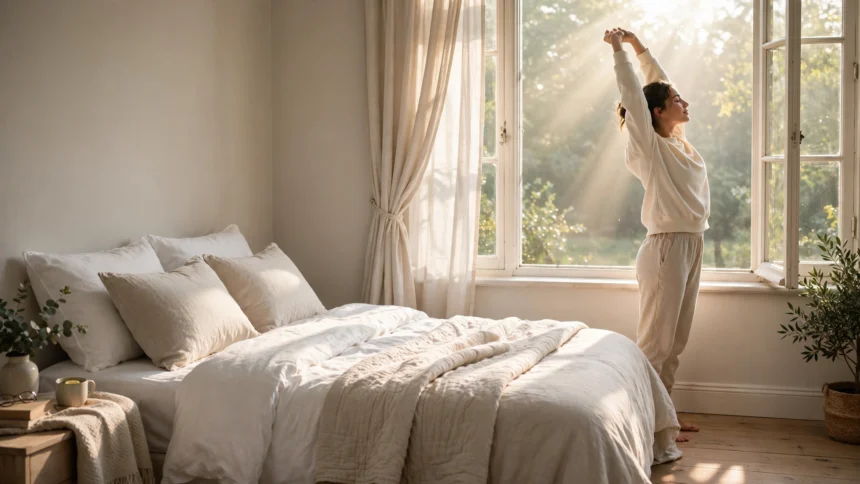
Sleep advice is a crowded market: magnesium, mouth tape, weighted blankets, apps that grade your night like an exam. Yet when sleep researchers are asked for the single habit with the strongest evidence behind it, most give the same unfashionable answer — get bright light into your eyes soon after waking. It costs nothing, takes ten minutes, and quietly reorganises the whole day that follows.
Your Body Runs on a Clock Set by Light
Deep in the brain sits a master clock that coordinates sleep, hunger, temperature and alertness across roughly twenty-four hours. Its main setting signal is light, picked up by specialised cells in the eyes that report brightness directly to the clock. As explainers from the National Institutes of Health describe, morning light is the strongest of these signals: it tells the clock the day has begun, which sets a timer for melatonin to rise some fourteen to sixteen hours later — right when you want to feel sleepy.
This is why two people can spend the same eight hours in bed and wake in different worlds. The one whose clock is well-set sleeps deeply at the right time. The one whose clock drifts — dim mornings, bright screens at midnight — sleeps at odds with their own biology.
What the Habit Changes
Falling asleep gets easier
People who adopt morning light routines consistently report the same first win: sleepiness arriving naturally in the evening instead of a wired second wind at 11 p.m. The clock, anchored early, stops negotiating.
Mornings stop hurting
Waking is governed by the same clock. When it is set properly, alertness rises on schedule and the groggy, hungover feeling of a bad alarm shrinks — even on the same total sleep. The Sleep Foundation notes that consistent light exposure is among the most reliable ways to ease exactly this kind of sleep inertia.
Energy moves to where you want it
An anchored clock concentrates alertness in the daytime hours. Afternoon slumps soften, and the late-evening restlessness that sends people scrolling — through feeds, channels and late-night streams like the ones in our TV and streaming corner — fades with it.
How to Build the Habit
The practice is almost embarrassingly simple. Within an hour of waking, spend ten to thirty minutes outside — a walk, coffee on the balcony, the school run on foot. Overcast days still deliver far more light than indoor lighting, so the habit works in most weathers; in dark winters, a bright light-therapy lamp at breakfast is the accepted substitute. Sunglasses defeat the purpose on the morning walk, though ordinary glasses and contact lenses are fine.
Pair it with the flip side: dim the last hour of the evening. Bright nights push the clock later just as reliably as bright mornings pull it earlier. The combination — bright starts, dim finishes — is the whole system.
A Week Is Enough to Feel It
Most people notice changes within four to seven days: easier evenings, lighter mornings, steadier afternoons. No app, no subscription, no equipment — just the oldest signal your biology knows, delivered on time. Of all the wellness habits competing for your attention this year, morning light may be the only one that is both ancient and proven. Step outside tomorrow and let the clock do the rest.